


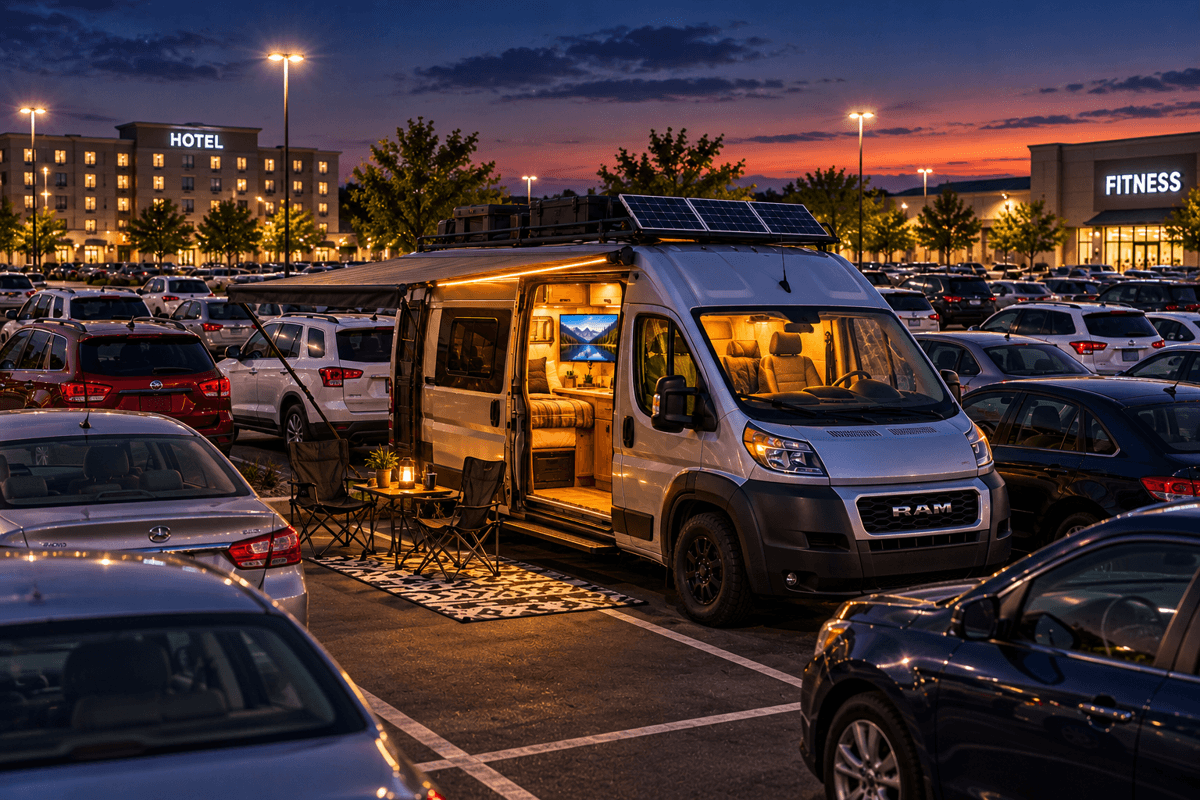
One of the biggest challenges of van life is finding somewhere to park and sleep for the night. Sure, you’re going to have some of those Instagram-worthy stays with beautiful backdrops you can enjoy out the back of your van, but there are going to be plenty of nights where that’s just not possible.
You can certainly find a campground near you, but they can get expensive, particularly if you’re traveling full-time, and sometimes you just need somewhere to get a few hours of sleep before continuing your journey. Campgrounds may also have restrictions about the types of vehicles they allow.
That’s where urban stealth camping comes in.
Stealth camping generally means spending the night in your vehicle without drawing attention to the fact that you’re sleeping inside. The idea is to blend in with the other parked vehicles around you rather than setting up an obvious campsite.
There are plenty of places where a parked van might go unnoticed. Some are better suited for stealth camping than others, depending on the type of vehicle you have, the surrounding neighborhood, and the amount of activity in the area.
First, a Word About Legality
Stealth camping is a park-at-your-own-risk activity.
Just because a location appears suitable for overnight parking doesn’t mean you’re legally allowed to sleep there. Some cities prohibit sleeping in vehicles, even when the vehicle is legally parked. Private property owners may also prohibit overnight parking or vehicle occupancy.
Depending on the circumstances and local laws, you could be asked to leave, receive a parking citation, have your vehicle towed, or potentially face trespassing charges. These consequences can vary considerably by location.
The places discussed below are simply locations that van lifers sometimes consider for overnight parking. They are not recommendations to park without permission or guarantees that overnight camping is permitted. It’s your responsibility to understand local regulations, respect private property, and decide whether a particular location is appropriate.
Stealth Camping “Rules”
There are no actual rules. Instead, consider the following items to be a list of best practices. If you follow these practices, you are more likely to avoid some of the problems that often come with stealth camping.
- You are there to sleep. Spend the day at a park or even in the parking lot at a different location. Once you get to your stealth camping location, you are there for the singular reason of sleeping.
- Arrive as late as you can. This minimizes the amount of time you spend there and the number of people you are likely to encounter.
- No lights! Again, you are there to sleep. Light attracts attention. Even using your cell phone may be enough to alert people of your presence. Pull in. Sleep.
- Sleeping, not camping! This may seem obvious, but you’re not going to put out your awning or use your outdoor kitchen. There’s not a more obvious way to draw plenty of attention to you.
- Stay in your vehicle! Yeah, people aren’t going to think a thing when you get out of the driver’s door and go in through the slider or back door. Any business you need to take care of needs to happen in your van… Also, refer to Rule #1.
- Wake early and leave. This may mean you only get six or seven hours of sleep. So be it. You need to be out of there before other people have started their normal morning routines and it becomes obvious you slept there. If you need to take a power nap late in the day, it’s pretty easy to do that during daylight hours.
- Never stay two nights in the same location. You may go unnoticed for a night. Try it a second night and store owners, employees, or customers are much more likely to take notice. No reason to push your luck.
- Cooperate if you get the knock. Don’t argue. Don’t ask for more time. Just comply and immediately drive away. Whether it’s the police, security, or a business owner, they really don’t want to go to the trouble of invoking consequences… Unless you give them a reason to. Just smile and let them know you will leave immediately.
- Have a backup location ready. Always know where you’re going if you don’t feel comfortable at a location or if you are asked to leave. It’s hard enough to identify potential locations during the day. Trying to do it at 3:00 in the morning is just asking for trouble.
Potential Urban Stealth Camping Locations
Again, these are not necessarily recommendations. These are more suggestions for when you can’t find a place with more straightforward legality. You’re too tired to drive and have to sleep. If things go wrong, refer to Rule #8 above.
1. Hotel Parking Lots
Hotels are one of the more obvious places to consider because overnight parking is a normal part of their business. Guests arrive and depart throughout the day and night, and vehicles routinely remain parked for extended periods.
Why it might work:
- Overnight vehicle parking is expected.
- Larger hotels may have extensive parking areas.
- Guests arrive and depart at all hours.
- A van may not look unusual among other travelers’ vehicles.
Things to consider:
- Some hotels, especially those in larger cities, require parking permits or registered license plates.
- Security cameras and patrols are common.
- Smaller hotels may have limited parking, making unfamiliar vehicles more noticeable.
- Hotels near airports or highways may have particularly active parking areas.
2. Hospital Parking Lots
Hospitals operate around the clock, making them another location where overnight parking is common. Employees work night shifts, and patients and visitors may remain at the hospital for extended periods. Just don’t take parking from the people who need to be there.
Why it might work:
- Vehicles regularly come and go throughout the night.
- Large hospitals often have extensive parking facilities.
- Overnight parking is part of normal hospital operations.
Things to consider:
- Hospital security can be particularly active.
- Some facilities use parking garages, gates, or controlled entrances.
- Emergency departments and shift changes can create considerable nighttime activity.
- Parking close to entrances may interfere with patients, visitors, and staff.
3. Industrial Parks
Industrial parks and warehouse districts can be relatively quiet after normal business hours. Depending on the area, there may also be commercial vehicles parked along nearby streets. Your big white van will look more at home in this environment.
Why it might work:
- Some industrial areas have very little nighttime traffic.
- Commercial vehicles are common.
- Certain districts have relatively few residential neighbors.
- Street parking may be available near warehouses and businesses.
Things to consider:
- Many warehouses and distribution centers operate overnight.
- Delivery trucks may arrive extremely early.
- Industrial areas can be isolated and poorly lit.
- Truck traffic and loading operations can be noisy.
4. Car Dealerships
Car dealerships are an interesting possibility because they’re surrounded by parked vehicles. Some also have service departments where customer vehicles remain overnight. In particular, you might be able to find a dealership that specializes in commercial vehicles. You could blend right in. Just get out of there before the manager gets there in the morning.
Why it might work:
- Large numbers of parked vehicles are normal.
- Some dealerships have substantial parking areas.
- Service departments may have vehicles parked overnight.
Things to consider:
- Dealerships often have extensive surveillance systems.
- Security personnel may closely monitor unfamiliar vehicles.
- Many dealerships have fenced inventory areas.
- A camper van may look noticeably different from the vehicles normally parked there.
Car dealerships may seem attractive at first glance, but their emphasis on security makes them a less appealing option than some other locations.
5. Residential Streets
Residential streets are another possibility, particularly in neighborhoods where street parking is common. A van parked along the curb may appear to belong to a resident or someone visiting nearby.
Why it might work:
- Street parking is normal in many neighborhoods.
- Some streets have relatively little nighttime traffic.
- Vehicles parked overnight may not attract much attention.
Things to consider:
- Residents tend to recognize unfamiliar vehicles.
- A large camper van may stand out among passenger cars.
- Dogs, outdoor lighting, and neighborhood activity can disturb your sleep.
- Parking directly in front of someone’s home may generate unwanted attention.
Residential areas can be quiet, but they’re also places where people are particularly aware of what happens around their homes.
6. Apartment Complexes
Large apartment complexes can have hundreds of vehicles parked overnight. With residents coming and going at different times, parking lots may remain active throughout the night. Stealth camping may not be possible at all apartment complexes but larger complexes without gated access might be an option.
Why it might work:
- Overnight parking is expected.
- Larger complexes have substantial numbers of vehicles.
- Residents and visitors may arrive at all hours.
Things to consider:
- Many complexes use resident parking stickers or permits.
- Some properties have gated entrances.
- Visitor parking may be limited.
- Residents and security personnel may recognize unfamiliar vehicles.
7. Office Parks
Office parks can have large parking areas that become nearly empty after employees leave for the day. Some facilities also have employees working late or overnight.
Why it might work:
- Parking lots may be quiet after business hours.
- Large office complexes often have substantial parking.
- Some buildings have employees working outside normal business hours.
Things to consider:
- An otherwise empty parking lot can make a single vehicle very noticeable.
- Security patrols may check buildings and parking areas.
- Maintenance and landscaping crews may arrive early.
- Some office parks have entrance gates or restricted access.
An empty parking lot isn’t always an advantage. Sometimes having a few other vehicles around makes a location feel more natural.
8. Park-and-Ride Lots
Park-and-ride facilities are designed for commuters who leave their vehicles while using public transportation or carpooling. Some are large facilities near highways, while others are smaller parking areas near transit stations.
Why it might work:
- Vehicles may remain parked for extended periods.
- Some facilities are accessible around the clock.
- Locations near highways can be convenient for travelers.
Things to consider:
- Many facilities have posted hours or overnight parking restrictions.
- Security cameras and patrols may be present.
- Commuters may begin arriving very early.
- Some lots are isolated after transit service ends.
9. 24-Hour Gyms and Fitness Centers
Fitness centers that operate around the clock have customers arriving and leaving at unusual hours. For van lifers who maintain gym memberships, these facilities can also provide access to showers and other amenities… And hey, if worst comes to worst, you could actually work out. Make your Van Life a healthy one!
Why it might work:
- Vehicles are present throughout the night.
- Parking areas are often well-lit.
- Members may have access to showers and restrooms.
- Some gyms are located in large shopping centers.
Things to consider:
- Gym parking areas may be relatively small.
- Staff members may recognize vehicles that remain parked for hours.
- Early morning workout crowds can create activity.
- Shared parking areas may have different management and rules from the gym itself.
10. Churches and Religious Facilities
Churches and other religious organizations sometimes have large parking lots that remain unused for much of the week. Some organizations are also willing to assist travelers who need a temporary place to stay. Just be aware that blending in in an empty parking lot is not really a thing. Not sure I would try this unless your vehicle is not visible from the street.
Why it might work:
- Parking areas may be quiet overnight.
- Some facilities have substantial unused parking.
- Certain organizations may grant permission for short overnight stays.
Things to consider:
- Religious facilities may have early morning or evening activities.
- Some properties have security systems.
- Parking lots can be very exposed when empty.
- Smaller facilities may be located close to residential homes.
Churches are one location where asking permission in advance may be particularly worthwhile.
11. Streets Near Automotive Repair Shops
Automotive repair districts often have vehicles parked along nearby streets, particularly where businesses service cars, trucks, and commercial vehicles.
Why it might work:
- Parked vehicles are common.
- Commercial vehicles may blend into the surroundings.
- Some repair districts have relatively little nighttime activity.
Things to consider:
- Repair shops may open very early.
- Tow trucks and service vehicles can create nighttime noise.
- Parking areas may be crowded with customer vehicles.
- Some businesses closely monitor vehicles parked nearby.
Final Thoughts
Urban stealth camping can be a way to reduce the cost of van life, particularly when traveling through areas where traditional campgrounds are expensive or difficult to find.
The locations discussed here have one thing in common: they’re places where parked vehicles may be a normal part of the surrounding environment. However, that doesn’t mean every location is suitable for sleeping overnight. Viability can be affected by your vehicle type and how well it blends with its surroundings.
Some van lifers are comfortable with the uncertainty of stealth camping, while others prefer the peace of mind that comes with staying somewhere overnight where vehicle sleeping is explicitly permitted.
Ultimately, the right approach depends on your vehicle, your comfort level, and the places you’re traveling through.
If you’re going to consider stealth camping, do your research, respect the people and properties around you, and always have another option available. A good night’s sleep is important, but so is waking up without an unexpected problem.