



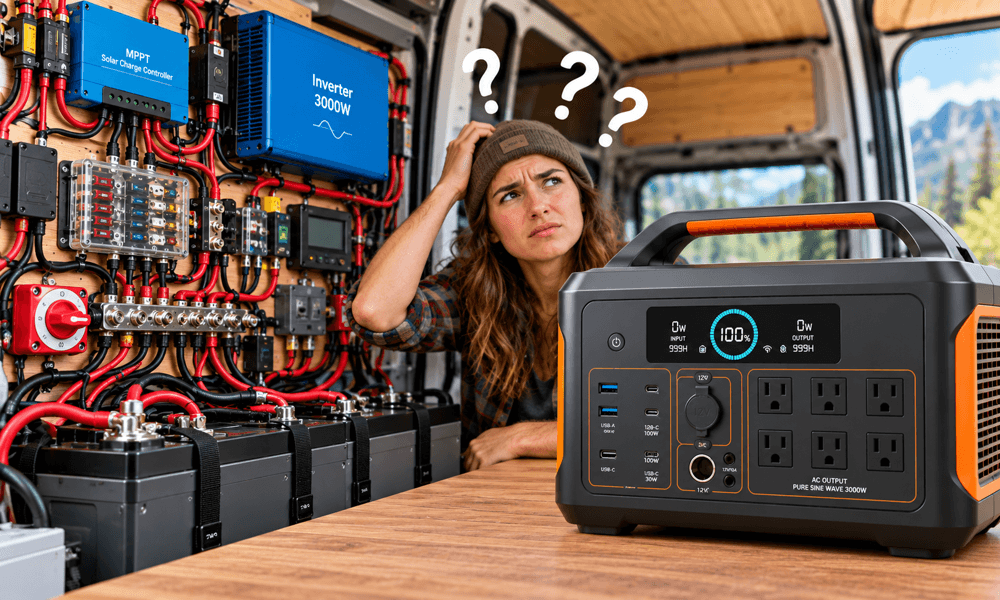
The electrical system may be the greatest obstacle for many people during a van build-out. Electricity is something we really can’t live without, yet a lot of people have very limited knowledge of how electrical systems work—or even how much power they actually need.
Start researching a traditional van electrical system, and things get complicated quickly. Suddenly you’re reading about lithium batteries, inverters, charge controllers, DC-to-DC chargers, bus bars, fuses, wire gauges, breakers, grounding, and solar panels. You start to feel like you need to become an electrician just to charge your phone and keep the refrigerator cold.
Fortunately, there’s another option.
Why Portable Power Stations are So Right for Van Life
Portable power stations have become incredibly capable, and for many van lifers, they offer a much simpler way to build an electrical system. Companies such as EcoFlow, Bluetti, Jackery, Anker, and others offer power stations ranging from small units designed for basic electronics to large systems capable of running much of a camper van.
A power station isn’t necessarily the right answer for everyone. But if you’re building your first van, using your van part-time, or simply want to keep things as easy and flexible as possible, it deserves serious consideration.
The biggest advantages come down to four things: simplicity, portability, redundancy, and adaptability.
Power Stations offer Simplicity
This is probably the biggest reason to consider a portable power station.
A traditional van electrical system isn’t one product. It’s a collection of components that have to work together. You’ll typically need a battery bank, inverter, solar charge controller, fuses, wiring, switches, and a way to charge the batteries from the vehicle.
You also have to make sure everything is properly sized and installed so that the system meets your needs and is safe to use.
A portable power station combines most of those components into one box.
The battery is inside. The inverter is inside. The solar charge controller is inside. The battery management system is inside. You usually get standard household outlets, USB ports, and 12-volt outputs built right into the unit.
Instead of designing an electrical system from scratch, you’re essentially buying one that has already been designed for you.
Charging is also straightforward. Depending on the model, you may be able to charge your power station from a household outlet, solar panels, your vehicle’s 12-volt outlet, or a higher-powered alternator charging system.
For someone who doesn’t know much about electricity and doesn’t particularly want to learn, this can remove one of the most intimidating parts of a van build.
That’s especially valuable for the Van Life WannaBe who wants to spend more time camping and traveling and less time figuring out whether they bought the correct size wire.
Power Stations Offer Portability
Traditional van electrical systems are generally built into the van. That’s fine until you want electricity somewhere other than the van.
A portable power station can go wherever you go. Heading to the beach? Take it with you. Camping at a picnic table 50 feet from your van? Bring the power station over and plug in your laptop, lights, or speaker. Need backup power inside your house during a power outage? Carry it inside. Want to use it in the garage or backyard? No problem.
This flexibility becomes even more valuable if you’re not a full-time van lifer.
Maybe you only take your camper van out a few weekends each month. With a traditional electrical system, thousands of dollars worth of batteries and electrical equipment may sit unused inside your van the rest of the time.
A portable power station can serve other purposes when you’re home.
Portability can also make it easier to change vehicles. If you start van life in a minivan and eventually upgrade to a cargo van, your power system doesn’t necessarily have to stay behind. Unplug it, pick it up, and move it into the next vehicle.
That’s difficult to do with an electrical system permanently installed behind walls and cabinets.
Power Stations Offer Redundancy
Here’s an advantage that doesn’t get discussed enough. Electrical systems can fail.
With a traditional system, one failed component can potentially cause a major problem. An inverter fails. A fuse blows. A connection comes loose. A charge controller stops working.
If you don’t know much about electrical systems, figuring out what went wrong while you’re sitting at a campsite can be frustrating.
Portable power stations allow you to build redundancy into your setup very easily. Instead of relying on one enormous power station, you can use two smaller ones.
One could handle your refrigerator and basic electronics while the other powers larger devices. If one unit develops a problem, you haven’t necessarily lost all of your electricity.
You can also rotate them.
One power station might be charging from solar panels while the other is being used inside the van. Later, you switch them.
For someone traveling far from home, having two independent sources of electricity can provide a lot of peace of mind.
It also allows you to separate essential and nonessential power.
Your refrigerator, phone, lights, and emergency equipment could be connected to one power station while another handles things like a television, coffee maker, induction cooktop, or laptop.
If you’re running low on power, you know exactly which system needs to be protected. If there’s a problem with one of the power stations, you can use the other for your essential needs and then buy another power station when you get the chance.
Power Stations Offer Adaptability
One of the biggest mistakes you can make when building your first camper van is assuming you already know exactly what you’ll need… You probably don’t.
Van life has a way of changing your plans.
Maybe you think you’ll cook with propane but later decide you love induction cooking. Maybe you start working remotely and suddenly need to power a laptop for eight hours a day. Maybe you add a refrigerator, Starlink, an electric blanket, or another device you hadn’t considered when you built the van.
A permanently installed electrical system can certainly be expanded, but doing so may require new batteries, additional wiring, larger fuses, or even a bigger inverter. And if you didn’t accommodate for these needs when you first installed your system, it can be a huge challenge.
Portable power stations make expansion much easier.
Need more power? Add another unit.
Need more solar? Add another compatible panel.
Want to power something outside? Move the power station.
Buying a larger van? Take your electrical system with you.
This is especially helpful for beginners because it allows your electrical setup to evolve along with your version of van life.
You don’t necessarily have to design the perfect system on day one.
Start with enough power to cover your basic needs. Use the van. Learn how much electricity you actually consume. Then expand your system if necessary.
That’s a much easier approach than trying to predict every appliance and electrical device you’ll use five years from now.
Power Stations Offer Affordability
This one’s not as cut-and-dried as the other benefits of portable power stations. There was a time when power stations were so expensive that a traditional electrical system was undoubtedly more affordable. That time is not now. The price difference between power stations and a traditional electrical system is almost negligible nowadays.
Someone experienced with installing electrical systems might be able to do it more affordably, but that depends on a whole lot of variables. With the other advantages of power stations listed above, I think the power station is a great answer for 90 percent of van lifers.
Best of Both Worlds – The Perfect Van Life Electrical System
This is one man’s opinion, and it might not be perfect for everyone, but here’s my version of the perfect electrical system for van life.
First, I’m going to have a large battery bank. I’m thinking 400 AH or more. This battery bank will be charged by solar and an alternator charger. Of course, we’ll also be able to charge it by hooking up to shore power.
These batteries will hook up to one large inverter, with just a few 120 outlets. This inverter would supply power for the two power stations you’re using, and maybe a portable air conditioner if you choose that luxury.
This system would be pretty simple without the need for fuse banks and such. Basically, it’s just the inverter and the power coming from the solar and the alternator, then the appropriate fuses.
I think this system meets the high power needs of a full build-out, but also all the advantages that modern portable power stations offer.